Benefits of Jigsaw Puzzle Game
12/19/2025
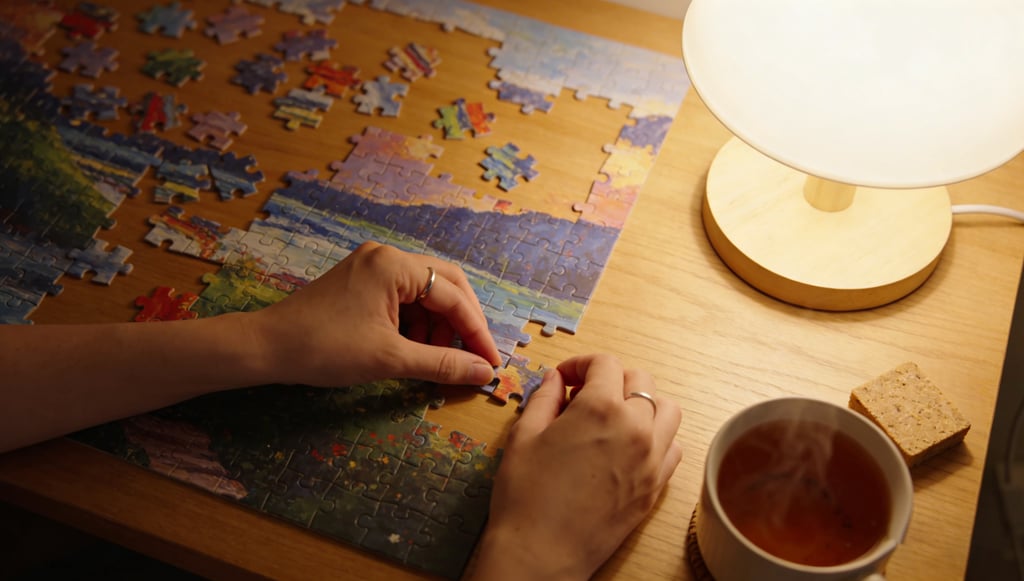
In moments of leisure, unpacking a jigsaw puzzle, scattering its colorful fragments across the table, and tracing the textured surface with fingertips—it's like embarking on a journey of self-reflection. Some say jigsaw puzzles are "the romance of a slow-paced era." In our fast-paced lives, they not only carry our delicate emotions but also subtly cultivate our hidden abilities. Those scattered fragments are like fragmented pieces of life; we piece them together little by little, ultimately gaining not only a complete picture but also a calmer, more perceptive self.
The process of jigsaw puzzles is an emotional journey, revealing our most authentic feelings. When first encountering a new puzzle, we are often filled with excited anticipation. Whether it's a soothing pastoral scene, a magnificent cityscape at night, or a cute cartoon or animal puzzle, the chosen image itself reflects our state of mind. Some crave tranquility and prefer natural landscapes puzzle, while others yearn for vibrancy and choose the hustle and bustle of everyday life puzzle. This anticipation allows us to put down our phones, set aside our daily tasks, and immerse ourselves in a moment of pure tranquility.
But this excitement is quickly replaced by confusion. When hundreds or even thousands of pieces are laid out before you, similar patterns and colors make it difficult to know where to begin, inevitably leading to frustration and anxiety. It's like facing a jumble of problems in life, that panic of not knowing where to start. At this point, the jigsaw puzzle becomes a test of your perseverance. Some will give up halfway, discarding the pieces; others will take a deep breath, starting with the straight-edged pieces, gradually building the outline. And when the first piece fits perfectly, when a small piece of the picture gradually takes shape, an indescribable sense of accomplishment arises spontaneously. This small joy is enough to dispel the previous frustration and become the motivation to continue.
The latter half of the puzzle requires more calm and focus. As the picture becomes more complete, our understanding of the whole becomes clearer. Each matching piece is a moment of perfect harmony. This focused state is like entering silent mode; the noise of the outside world is shut out, leaving only the exploration of your fingertips and inner peace. For adults burdened by life's pressures, this is the gentlest form of healing. There's no need to dwell on complex interpersonal relationships or agonize over unfinished works; simply focus on the small goal at hand. With each piece pieced together, anxiety and fatigue are slowly released. When the final fragment is inserted, revealing the complete picture, we have a profound sense of accomplishment. Those seemingly unrelated fragments all have their own place, just like the seemingly scattered experiences in our lives, which will eventually connect to form a unique life panorama.
Jigsaw puzzles are like a hidden skill training course, subtly cultivating various core competencies within us.
First and foremost are focus and patience. In this technologically advanced age, our attention is easily distracted by fragmented content, while jigsaw puzzles require us to concentrate on a single goal for extended periods. From distinguishing similar colors and patterns to sifting through hundreds or even thousands of pieces to find the right one, every step tests our focus. Facing the predicament of not finding a matching piece immediately, and the repeated attempts and failures, we need to calm down and be patient. This patience will gradually transfer to our lives and work, allowing us to face challenges without panic or helplessness.
Secondly, jigsaw puzzles significantly improve logical thinking and spatial imagination. When assembling the puzzle, we need to first have a macroscopic understanding of the overall picture, then break it down into smaller areas. For example, first determine the general boundaries of the sky, the ground, and the buildings, then gradually refine the details. This "whole-to-part" thinking approach is the core of logical thinking. At the same time, we also need to construct the three-dimensional shape of the fragments in our minds and imagine how they fit together with other fragments. The benefits of this for developing spatial imagination are self-evident.
Especially for children, puzzles help them better understand shapes, colors, and spatial relationships, laying the foundation for the development of abstract thinking.
Furthermore, jigsaw puzzles can cultivate problem-solving skills and resilience. When we encounter a puzzle we can't solve, do we blindly search for pieces, or do we proactively adjust our strategy? For example, would we consider changing to a different area, or re-examine the completed parts for clues? This proactive process of seeking solutions cultivates problem-solving abilities. The experience of trying again and again, failing, and starting anew also teaches us to face setbacks.
Not finding the puzzle temporarily doesn't mean the pieces don't exist; it just means we haven't found the right method yet. Cultivating this mindset will prevent us from being defeated by life's difficulties.
Today, more and more people use jigsaw puzzles as a way to de-stress, which actually reflects a yearning for a slower pace of life and a need for self-growth. There's no fastest way to solve a jigsaw puzzle, just like life itself. What matters isn't how fast you go, but whether you can calmly observe your emotional changes and grow continuously while solving problems.
Having read this, why not take apart a jigsaw puzzle on a leisurely afternoon, using the scattered pieces to create a moment of tranquility, and also to piece together a clearer and stronger version of yourself?
Help
Connect
support@pulezzforu.com
© 2025 PULEZZFORU.